“de Etalage”, June 2014
Technological developments have increased the accessibility of photography for the general public. Mobile phones are equipped with high-quality cameras. At any time of the day and anywhere in the world, we have the opportunity to take photos and share them with those around us.
Nowadays, we share our private whims via social media. We point our cameras at our personal wishes, desires, peculiarities, vulnerabilities, activities, and truths. The public sphere is experienced as an extension of the living room. Exactly this whimsy, which characterizes the private sphere, increasingly manifests itself in public space and reclaims it. The boundary between communal space and private territory seems to become more blurred and cause confusion.
What consequence does this development have for the way we look at the images we share with one another? And what questions can we raise in this regard?
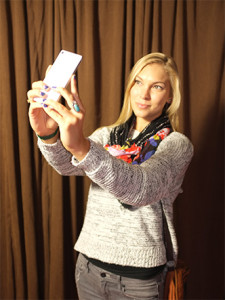
Today, we also turn the camera very literally upon ourselves: the selfie. A selfie is a photographic self-portrait where the photographer is simultaneously the subject. A selfie is not a selfie if this fact is not communicated to ‘us’ by the ‘speaker’ through the image. This connection implies honesty, openness, transparency, or ‘authenticity’. Furthermore, this honesty is emphatically ‘proven’ by the action itself: capturing the act of taking the photo by the person standing in front of the camera within the final image. Nothing suggests that the photographer aims to cover up or distort any truth or honesty for the audience. It is a ‘my actual here and now to you’. A self-confession. Or are we speaking here rather of a form of self-staging?
The appeal of the selfie is self-determination. However, in the case of the selfie, there seems to be a curious clash between the role of the photographer and the role of the subject. How can both be the same person? Whose interest yields to the other? How does the self-observed nature of the selfie relate to the voyeuristic character of photography—namely, looking from an unobserved vantage point, using the camera as a keyhole? The classic concept of being ‘behind the camera’ is no longer there.
To which part of this construction between photographer and subject does the selfie make the greatest appeal to us as an audience? What is the dominant direction of address here? What are we actually looking at? What value does the selfie hold without the grace of being transmitted to the audience? But above all, what does the popularity of the selfie in a society driven by photographic imagery mean for the way we connect with each other and are ‘in the picture’?
“De Etalage” is an ongoing project in which I, as an artist, entice the public into discussion. By presenting questions and reflections about the selfie, I want to open a conversation about the absolute certainty with which we take and share photos of ourselves.